Message in What We Buy, but Nobody’s Listening
By JOHN TIERNEY
Published: May 18, 2009
Why does a diploma from Harvard cost $100,000 more than a similar piece of paper from City College? Why might a BMW cost $25,000 more than a Subaru WRX with equally fast acceleration? Why do “sophisticated” consumers demand 16-gigabyte iPhones and “fair trade” coffee from
If you ask market researchers or advertising executives, you might hear about the difference between “rational” and “emotional” buying decisions, or about products falling into categories like “hedonic” or “utilitarian” or “positional.” But Geoffrey Miller, an evolutionary psychologist at the University of New Mexico, says that even the slickest minds on Madison Avenue are still in the prescientific dark ages.
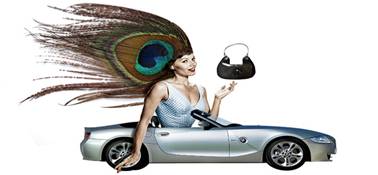
Instead of running focus groups and spinning theories, he says, marketers could learn more by administering scientifically calibrated tests of intelligence and personality traits. If marketers (or their customers) understood biologists’ new calculations about animals’ “costly signaling,” Dr. Miller says, they’d see that Harvard diplomas and iPhones send the same kind of signal as the ornate tail of a peacock.
Sometimes the message is as simple as “I’ve got resources to burn,” the classic conspicuous waste demonstrated by the energy expended to lift a peacock’s tail or the fuel guzzled by a Hummer. But brand-name products aren’t just about flaunting transient wealth. The audience for our signals — prospective mates, friends, rivals — care more about the permanent traits measured in tests of intelligence and personality, as Dr. Miller explains in his new book, “Spent: Sex, Evolution and Consumer Behavior.”
Suppose, during a date, you casually say, “The sugar maples in Harvard Yard were so beautiful every fall term.” Here’s what you’re signaling, as translated by Dr. Miller:
“My S.A.T. scores were sufficiently high (roughly 720 out of 800) that I could get admitted, so my I.Q. is above 135, and I had sufficient conscientiousness, emotional stability and intellectual openness to pass my classes. Plus, I can recognize a tree.”
Or suppose a young man, after listening to the specifications of the newest iPhone or hearing about a BMW’s “Servotronic variable-ratio power steering,” says to himself, “Those features sound awesome.” Here’s Dr. Miller’s translation:
“Those features can be talked about in ways that will display my general intelligence to potential mates and friends, who will bow down before my godlike technopowers, which rival those of Iron Man himself.”
Most of us will insist there are other reasons for going to Harvard or buying a BMW or an iPhone — and there are, of course. The education and the products can yield many kinds of rewards. But Dr. Miller says that much of the pleasure we derive from products stems from the unconscious instinct that they will either enhance or signal our fitness by demonstrating intelligence or some of the Big Five personality traits: openness, conscientiousness, agreeableness, stability and extraversion.
In a series of experiments, Dr. Miller and other researchers found that people were more likely to expend money and effort on products and activities if they were first primed with photographs of the opposite sex or stories about dating.
After this priming, men were more willing to splurge on designer sunglasses, expensive watches and European vacations. Women became more willing to do volunteer work and perform other acts of conspicuous charity — a signal of high conscientiousness and agreeableness, like demonstrating your concern for third world farmers by spending extra for Starbucks’s “fair trade” coffee.
These signals can be finely nuanced, as Dr. Miller parses them in his book. The “conspicuous precision” of a BMW or a Lexus helps signal the intelligence of all the owners, but the BMW’s “conspicuous reputation” also marks its owner as more extraverted and less agreeable (i.e., more aggressive). Owners of Toyotas and Hondas are signaling high conscientiousness by driving reliable and economical cars.
But once you’ve spent the money, once you’ve got the personality-appropriate appliance or watch or handbag, how much good are these signals actually doing you? Not much, Dr. Miller says. The fundamental consumerist delusion, as he calls it, is that purchases affect the way we’re treated.
The grand edifice of brand-name consumerism rests on the narcissistic fantasy that everyone else cares about what we buy. (It’s no accident that narcissistic teenagers are the most brand-obsessed consumers.) But who else even notices? Can you remember what your partner or your best friend was wearing the day before yesterday? Or what kind of watch your boss has?
A Harvard diploma might help get you a date or a job interview, but what you say during the date or conversation will make the difference. An elegantly thin Skagen watch might send a signal to a stranger at a cocktail party or in an airport lounge, but even if it were noticed, anyone who talked to you for just a few minutes would get a much better gauge of your intelligence and personality.
To get over your consuming obsessions, Dr. Miller suggests exercises like comparing the relative costs and pleasures of the stuff you’ve bought. (You can try the exercise at nytimes.com/tierneylab.) It may seem odd that we need these exercises — why would natural selection leave us with such unproductive fetishes? — but Dr. Miller says it’s not surprising.
“Evolution is good at getting us to avoid death, desperation and celibacy, but it’s not that good at getting us to feel happy,” he says, calling our desire to impress strangers a quirky evolutionary byproduct of a smaller social world.
“We evolved as social primates who hardly ever encountered strangers in prehistory,” Dr. Miller says. “So we instinctively treat all strangers as if they’re potential mates or friends or enemies. But your happiness and survival today don’t depend on your relationships with strangers. It doesn’t matter whether you get a nanosecond of deference from a shopkeeper or a stranger in an airport.”
More Articles in Science » A version of this article appeared in print on May 19, 2009, on page D1 of the New York edition.
By Ray Fisman
Posted Friday, Jan. 11, 2008, at 7:44 AM ET in Slate
 Bill
Cosby
A few years ago, Bill Cosby set off a firestorm with a speech excoriating his
fellow African-Americans for, among other things, buying $500 sneakers instead
of educational toys for their children. In a recent book,
Come On People,
he repeats his argument that black Americans spend too much money on designer
clothes and fancy cars, and don't invest sufficiently in their futures.
Bill
Cosby
A few years ago, Bill Cosby set off a firestorm with a speech excoriating his
fellow African-Americans for, among other things, buying $500 sneakers instead
of educational toys for their children. In a recent book,
Come On People,
he repeats his argument that black Americans spend too much money on designer
clothes and fancy cars, and don't invest sufficiently in their futures.
Many in the black community have been critical of Cosby for blaming poor people rather than poor public policies. Others have defended Cosby's comments as an honest expression of uncomfortable truths. But notably absent from the Cosby affair have been the underlying economic facts. Do blacks actually spend more on consumerist indulgences than whites? And if so, what, exactly, makes black Americans more vulnerable to the allure of these luxury goods?
Economists Kerwin Charles, Erik Hurst, and Nikolai Roussanov have taken up this rather sensitive question in a recent unpublished study, "Conspicuous Consumption and Race." Using data from the Consumer Expenditure Survey for 1986-2002, they find that blacks and Hispanics indeed spend more than whites with comparable incomes on what the authors classify as "visible goods" (clothes, cars, and jewelry). A lot more, in fact—up to an additional 30 percent. The authors provide evidence, however, that this is not because of some inherent weakness on the part of blacks and Hispanics. The disparity, they suggest, is related to the way that all people—black, Hispanic, and white—strive for social status within their respective communities.
Every society has had its equivalent of the $150 Zoom LeBron IV basketball sneaker, and thanks to Thorstein Veblen, we have a pretty good idea why. As the Gilded Age economist famously put it, "conspicuous consumption of valuable goods is a means of reputability to the gentleman of leisure," and "failure to consume a mark of demerit." To consume is to flaunt our financial success; it's how we keep score in life.
Economists refer to items that we purchase in order to reveal our prosperity to others as wealth signals. But why use sneakers, as opposed to phonics toys, as a wealth signal? First off, for a signal to be effective, it needs to be easily observed by the people we're trying to impress. This includes not just those near and dear to us, but also the person we pass on the street, who sees our sneakers but would have a harder time inferring how much we're spending teaching our kids to read. For a wealth signal to be credible, it also needs to be hard to imitate—if everyone in your community can afford $150 sneakers, those Zoom Lebron IVs would lose their signal value.
In general, the poorest people in any group are forced to opt out of the conspicuous consumption arms race—if you can't afford the signal, even by stretching your finances, you can't play the game. I, a humble economics professor, don't try to compete in a wealth-signaling game with the Wall Street traders whom I see on the streets of Manhattan. But this still leaves us with the question of why a black person would spend so much more in trying to signal wealth than a white person. The Cosby explanation—that there is simply a culture of consumption among black Americans—doesn't quite cut it for economists. We prefer to account for differences in behavior by looking to see if there are differing incentives.
Why would otherwise-similar black and white households have different incentives to signal their wealth? Charles, Hurst, and Roussanov argue that it's because blacks and whites are seeking status in different communities. In the racially divided society we live in, whites are trying to impress other whites, and blacks are trying to impress other blacks. But because poor blacks are more likely to live among other poor blacks than poor whites are to live among other poor whites, poor black families are more susceptible to being pulled into a signaling game with their neighbors.
Consider, for example, a black family and a white family each earning $42,500 a year, the median income for a black household during the 1990s. This black family sees that other black families are buying cars, clothes, and other wealth signals that, while stretching this black family's financial resources thin, are technically affordable for a family making $42,500. So, this family decides to buy them, too, in order to keep up with the conspicuous consumers that they compare themselves with.
Now take the white family making $42,500. The average household income among whites in the 1990s was much higher—$66,800. This white family looks around the neighborhood and is more likely to see white families spending on luxuries that are simply beyond their financial reach. The white family making $42,500 is thus too poor to participate in a signaling game with its neighbors, so they don't. As a result, they're spared the cost of competing, just as I am spared the expense of trying to compete with the Wall Street traders I see driving around Manhattan in their Mercedes sedans.
To test their theory, the authors look at how much a white family spends on conspicuous consumption when it is surrounded by white families making a similar amount of money. They find that this white family spends the same portion of its income on visible goods as a black family surrounded by other black families with similar incomes. They also find that the further a family of either race slips behind the average income of nearby households of the same race (becoming too poor to compete in the signaling game), the less it spends on these visible goods.
Once these effects are accounted for, racial disparities in visible consumption disappear. It's not that black Americans are more inclined to signal wealth; rather, poor blacks are more likely than poor whites to be a part of communities where they are relatively rich enough to participate in the signaling game.
If signaling is just part of a deeper human impulse to seek status in our communities, what's wrong with that, anyway? If a household chooses to spend a lot on visible consumption because it gets happiness from achieving high standing among its neighbors, why should we care? To return to Cosby's concerns, if blacks are spending more on shoes and cars and jewelry, they must be spending less on something else. And that something else turns out to be mostly health and education. According to the study, black households spend more than 50 percent less on health care than whites of comparable incomes and 20 percent less on education. Unfortunately, these are exactly the investments that the black families need to make in order to close the black-white income gap.
In his controversial speech, Bill Cosby appealed to the African-American community to start investing in their futures. What's troubling about the message of this study is that Cosby and others may not be battling against a black culture of consumption, but a more deeply seated human pursuit of status. In this sense, Cosby's critics may be right—only when black incomes catch up to white incomes will the apparent black-white gap in spending on visible goods disappear.